
Storm Scams in Northeast Ohio: What to Watch For and How to Stay Safe
After the storms come the scams.
Storm scams in Northeast Ohio are rising, and the scammers move faster than the cleanup crews.
Here in Lorain County and the surrounding region, a summer sky can go from calm to catastrophic in minutes.
Damaging winds, torrential rains, lightning strikes, and hail can leave trails across entire neighborhoods.
A tree limb crashes through a roof. Rainwater seeps up into a basement. Wind rips siding off a garage. Hail dents every car on the street.
Before the debris is cleared and before your nerves have settled, another kind of storm moves in. Scammers watch the weather too. They know a fallen tree and a stressed homeowner make an easy target, and they show up fast with a plan already in motion.
You don't have to become an expert in fraud detection to protect yourself. You just need to know what these scams look like before they knock on your door, call your phone, or land in your mailbox.
Here are three real, documented storm scams, plus the simple steps that stop them cold.
Scam #1: The Storm-Chasing Contractor
After a hailstorm tore through the Cleveland area, the Better Business Bureau issued a warning about people going door to door offering tree removal and repair services on the spot.
Ericka Dilworth of the BBB described these individuals as "storm chasers" who target homeowners in the emotional aftermath of a storm, when a fast promise feels like relief. She noted that victims in the region have lost anywhere from a couple hundred dollars to thousands of dollars this way.
This is not a hypothetical. Ohio Attorney General Dave Yost filed a lawsuit against a Virginia-based contractor accused of taking more than $188,000 from Northeast Ohio homeowners for roofing and siding work tied to 2024 storm damage.
The Attorney General's office received two dozen complaints from homeowners who paid deposits and received no completed work. The lawsuit, filed in Cuyahoga County, describes a business that promised to work directly with customers' insurance companies and then failed to deliver.
The problem is growing nationwide. According to the National Insurance Crime Bureau, reported instances of contractor fraud increased 38% from 2023 to 2025 across the United States. In communities like ours that regularly deal with severe weather seasons, that number is worth taking seriously.
🛡️ How to protect yourself from contractor fraud
Never hire someone who shows up unannounced right after a storm. Take their information, close the door, and research the company on your own time.
Check the contractor's license through the Ohio Department of Commerce and look them up with the Better Business Bureau before you sign anything.
Get written estimates. Be cautious of any quote that comes in far below the others.
Never pay the full amount up front. A third to half is standard for a deposit, with the balance due once the work is complete and you're satisfied.
Avoid cash transactions. A credit card gives you a way to dispute the charge if something goes wrong.
Never sign a form authorizing a contractor to deal directly with your insurance company or to receive your insurance check. That check belongs in your hands first.
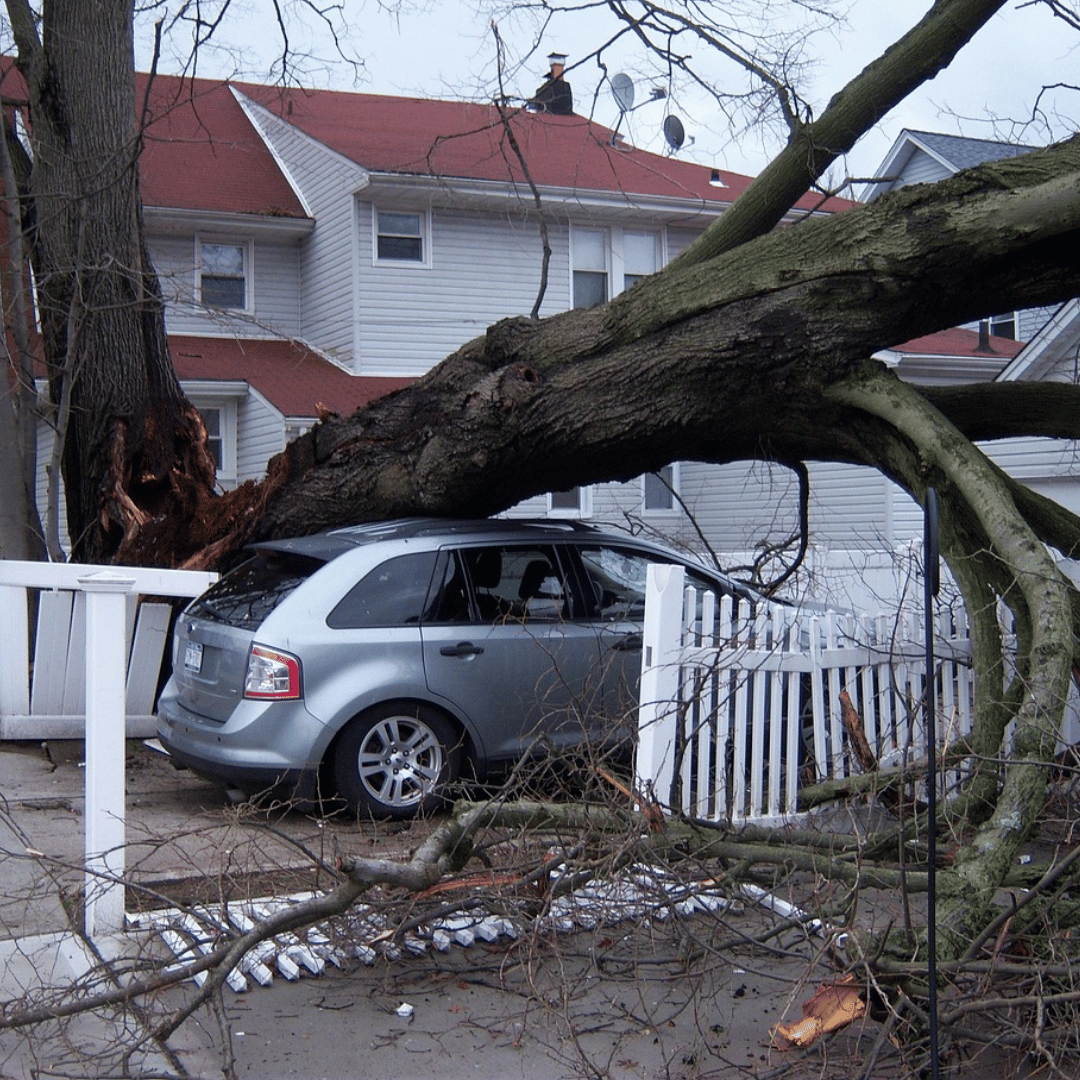
Scammers watch the weather too. They know a fallen tree and a stressed homeowner make an easy target.
Scam #2: The Utility Impostor
Storm damage often knocks out power lines, gas connections, or water service. That creates the perfect cover for a different kind of scammer.
The Federal Trade Commission warns that utility impostors call or show up in person claiming your equipment needs urgent repair or replacement. They ask for payment, often on the spot, before any real utility worker would even reach your street.
These scammers count on urgency to exploit your fears. A homeowner without power, worried about a gas leak or a downed line, is far less likely to stop and verify credentials. That's exactly what they're banking on.
🛡️How to protect yourself from utility impostors
Ask for identification before you let anyone claiming to represent a utility company onto your property.
Call your actual utility provider using the number on your bill or their official website to confirm the visit is legitimate.
Never hand over payment to someone who arrives unannounced. Real utility companies do not collect payment for emergency repairs at your front door.
If anything feels rushed or pressured, trust that instinct and ask them to leave your property.
Scam #3: The Insurance and FEMA Phishing Scam
The days after a storm bring phone calls, texts, and letters about insurance claims and disaster relief. Some of them are real. Many are not. The Federal Communications Commission warns that scammers pose as insurance representatives or government officials asking for policy numbers, coverage details, or payment before they will "process" your claim.
The FTC has also tracked a resurgence of mailed letters claiming you have unclaimed insurance money waiting — all designed to get you on the phone so a scammer can ask for your Social Security number or bank account information.
A related version targets people trying to access FEMA disaster assistance. Scammers claim they can guarantee approval or speed up your funds, but it will cost you a fee.
FEMA never charges an application fee. If someone asks you to pay for help with qualifying, that is the clearest sign of a scam.
🛡️ How to protect yourself from insurance and FEMA phishing scams
Do not give out policy numbers, coverage details, or personal information to anyone who calls you first.
Hang up and call your insurance agent or company directly using the number on your policy documents or statement — not a number the caller gives you.
Remember: FEMA never charges an application fee. Anyone asking for money to help you qualify for disaster relief is running a scam.
If a letter arrives claiming unclaimed insurance money, do not call the number provided. Set it aside and contact your insurance company directly if you want to verify.
Report suspected fraud to the FEMA Disaster Fraud Hotline at 1-866-720-5721 or to the FTC at ReportFraud.ftc.gov.
Achieve Credit Union Is Here to Help You Recover the Right Way
A storm is stressful enough without a scammer adding to the damage. If you ever feel unsure about a call, a knock at the door, or a request for payment tied to storm repairs or insurance, slow down before you act. Verify first.
If something ever feels off with your Achieve accounts during this process — an unexpected charge, a suspicious request, or a question about how to safely handle an insurance payment — we're here.
Call us at (440) 324-3400, or stop into any of our branch locations in Elyria, Lorain, or LaGrange.
Guiding you through the hard moments is what we're here for, storm season and every season after it.
Take The Next Step.
Visit A BranchStop by your local branch, and we’ll be happy to help you!SEE LOCATIONS |
Talk With UsCall (440) 324-3400 to speak with our Member Services team.CALL US |
Become a MemberIt’s easy to join Achieve CU and open your account.JOIN US |
About the Author

Scott Nelson
Scott Nelson has served as Achieve Credit Union’s Marketing Director since 2022. Scott’s a big fan of credit unions and the positive impact they have on the local communities they serve.
Fun fact: You may see Scott at your local high school baseball games - as an umpire.